
7 Critical Signs You Need a Fractional Finance Director for Your SME
Imagine your sales are climbing, yet your bank balance remains stubbornly low. You're working harder than ever, but the financial clarity you need to scale feels further away than it was when you started. Recognising the signs you need a fractional finance director is often the first step towards regaining control over your business's future. It's a common frustration for UK business owners who find themselves buried in spreadsheets instead of leading their teams. You might feel a nagging sense of unease when looking at your monthly reports, or perhaps you're simply tired of making big decisions based on gut instinct rather than hard data.
This article will help you identify the critical indicators that your current finance function has reached its limit. We'll explore how fractional leadership provides the steady hand and strategic foresight needed to move from reactive survival to intentional growth. By the end of this guide, you'll understand the seven key signals that it's time to bring in senior-level guidance to stabilise your cash flow, improve visibility, and plan your next phase of expansion with absolute confidence. You'll discover how to transition from financial uncertainty to a state of calm, professional stability.
Table of Contents
The SME Growth Paradox: Why Success Often Leads to Financial Uncertainty
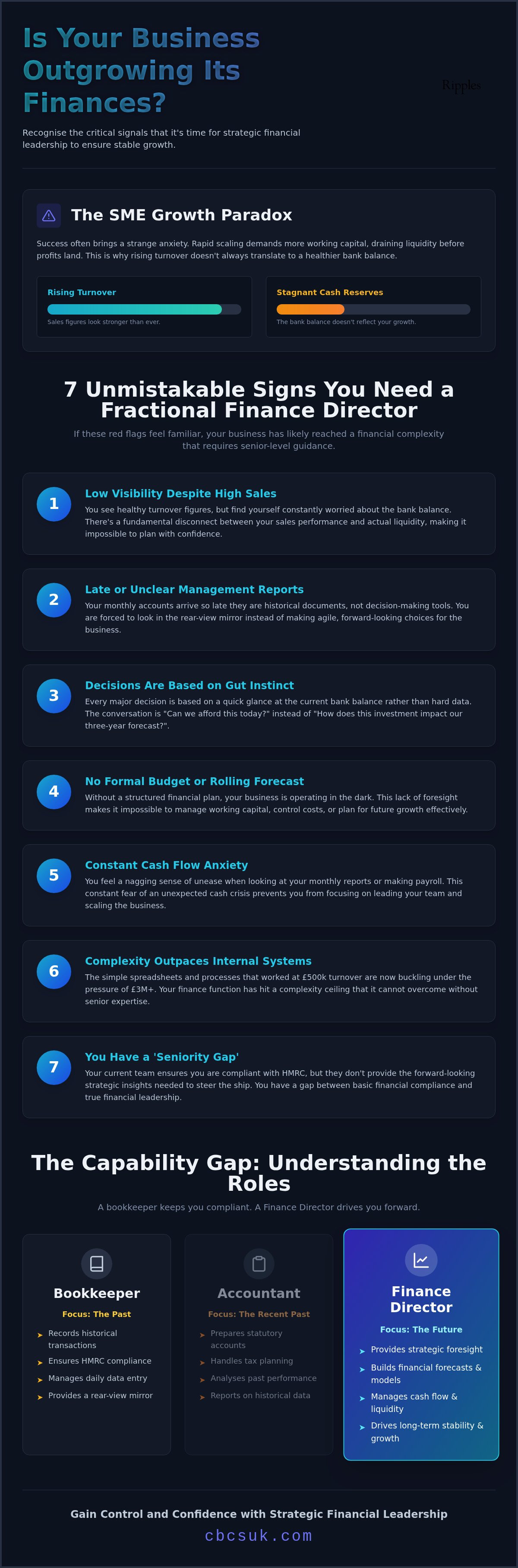
Success in business often brings a strange, quiet anxiety. You see your turnover rising month after month, yet your cash reserves don't seem to reflect that growth. This is the SME growth paradox. It happens because rapid scaling demands more working capital, higher stock levels, and larger teams, all of which drain liquidity before the profits actually land. Many founders find themselves in a position where they're too big to be small, but too small to be big. If you feel like you're losing visibility of your finances despite healthy sales, these are common signs you need a fractional finance director to bridge the gap.
Recognising that feeling overwhelmed at this stage isn't a failure of leadership is crucial. It's a natural evolution. Systems that worked perfectly when you were turning over £500,000 will inevitably buckle once you cross the £2 million or £5 million mark. The transition from founder-led intuition to data-driven strategy is a necessary hurdle for any business aiming for long-term stability. It requires moving away from gut feel and towards a structured, professional framework.
The Threshold of Complexity
Most UK SMEs hit a financial ceiling once they reach a certain headcount or revenue threshold. Research suggests that fractional services are becoming increasingly common for businesses with £3 million to £5 million in turnover, as this is where complexity often outpaces internal capacity. At this stage, keeping the books is no longer enough to ensure survival. Whilst a bookkeeper ensures you're compliant with HMRC, they rarely provide the forward-looking insights needed to steer the ship through turbulent waters. The Seniority Gap is the distance between basic financial compliance and the strategic leadership required to drive sustainable growth.
Moving from Reactive to Intentional Leadership
Founders often fall into the reactive trap, where every major business decision is based on a quick glance at the current bank balance. This instinctual behaviour works in the early days, but it becomes dangerous as complexity grows. Professional intervention helps you move from reactive fire-fighting to intentional, planned action. By understanding what is a fractional executive?, you can see how high-level expertise can be integrated into your business on a part-time basis without the cost of a full-time hire.
Bringing in a safe pair of hands allows you to organise your financial chaos into a structured roadmap. It changes the conversation from "can we afford this today?" to "how does this investment impact our three-year forecast?" This shift provides the peace of mind needed to scale without the constant fear of an unexpected cash flow crisis. It's about moving from a state of confusion to one of absolute clarity.
7 Unmistakable Signs You Need a Fractional Finance Director
Identifying the point where your business has outgrown its current financial structure is a vital step for any scaling SME. It's rarely a single event that triggers this realisation, but rather a collection of subtle red flags that suggest your internal systems are no longer fit for purpose. Recognising the signs you need a fractional finance director early can prevent costly mistakes and provide the necessary visibility to protect your margins.
Visibility and Forecasting Red Flags
The most common symptom of a seniority gap is a disconnect between sales performance and liquidity. You might see healthy turnover figures on your dashboard, yet find yourself constantly worried about the bank balance. This happens when there's a lack of focus on working capital and credit control. Without a formal budget or rolling forecast, you're essentially operating in the dark.
Timing is equally critical. If your monthly management accounts arrive twenty days after the month-end, they're little more than ancient history. You cannot make agile decisions for the future whilst looking in the rear-view mirror. Transitioning to a model that offers real-time visibility allows for intentional leadership rather than reactive survival. Understanding the benefits of a fractional CFO helps founders see how senior-level experience can transform raw data into a strategic roadmap.
Sign 1: Healthy sales are present, but cash reserves feel unpredictable or dangerously low.
Sign 2: Management reports arrive too late to influence current operational decisions.
Sign 3: You make significant capital or hiring decisions based on gut feel rather than detailed forecasts.
Sign 4: Your current finance person is an excellent bookkeeper but struggles with complex "what if" strategic modelling.
Sign 5: External stakeholders, such as banks or investors, are asking technical questions you cannot answer with certainty.
The Human Element: Stretched Teams and Founder Burnout
Founder fatigue is a genuine risk when you carry the burden of financial risk alone. If you find yourself spending more time buried in spreadsheets than on your core business strategy, you've reached a ceiling (Sign 6). This often coincides with your finance manager reaching their own technical limit; they may be superb at compliance but lack the experience to handle high-level growth planning.
Finally, preparing for a major milestone-such as a fundraise, a business sale, or a complex franchise audit-requires a level of precision that standard bookkeeping cannot provide (Sign 7). A fractional FD retainer acts as a safe pair of hands during these high-stakes periods. It ensures your business is presented in the best possible light to external parties whilst removing the confusion that often surrounds complex financial transitions. Spotting these signs you need a fractional finance director allows you to intervene before the weight of growth becomes unmanageable.
The Capability Gap: Bookkeeper vs. Accountant vs. Finance Director
Many business owners assume that as long as they have an accountant, their finance function is "covered." However, a healthy finance department is a hierarchy of distinct skill sets, each serving a different purpose. One of the clearest signs you need a fractional finance director is when your existing team performs their tasks perfectly, yet you still feel a lack of strategic direction. An FD does not replace your bookkeeper; they provide the layer of high-level insight that sits above them to ensure every financial decision aligns with your long-term goals.
Defining the Finance Hierarchy
To build a stable foundation, it's helpful to understand the specific responsibilities at each level of the finance function. Confusion often arises because the titles are sometimes used interchangeably in smaller firms. Here is how a professional structure should look:
Bookkeeper: Primarily focused on historical accuracy. They process invoices, manage VAT returns, and ensure every transaction is recorded correctly within your software.
Financial Controller: Focuses on the "now." They implement internal controls, manage the finance team, and produce the monthly management accounts that keep the business running.
Finance Director: Focuses on the "future." They handle strategy, rolling forecasts, and commercial risk management. This is board-level leadership that converts raw numbers into a growth-driving roadmap.
Why an External Accountant Isn’t Always the Answer
Many SMEs rely on an external accounting firm for their year-end filings. Whilst these firms are essential for compliance, their focus is often retrospective. They look at what happened last year to satisfy HMRC requirements. In contrast, a fractional FD is a hands-on partner who understands the day-to-day behaviour of your specific business. They are interested in your liquidity next month, not just your tax bill from last year. They act as a strategic mentor rather than a distant consultant.
Seniority matters when you are scaling. Founder Chris Burton brings over 25 years of experience to the table, providing a safe pair of hands that standard compliance-led firms often cannot match. This level of expertise ensures your business moves from instinctual reactions to intentional, informed action. It's an investment in stability, ensuring you have the clarity to make bold decisions without the fear of hidden risks. Recognising the signs you need a fractional finance director allows you to fill this capability gap before it begins to hinder your progress.
The Strategic Impact: How Fractional Support Organises Your Future
The real value of fractional leadership lies in the transition from instinctual reactions to informed, intentional action. While the early signs you need a fractional finance director often involve feelings of uncertainty, the result of professional intervention is absolute clarity. It's about de-risking your future by ensuring every growth decision is backed by rigorous data rather than hope. This shift allows you to move away from the daily stress of the unknown and towards a structured plan for long-term stability.
Mastering Cash Flow and Liquidity
Liquidity is the lifeblood of any scaling SME, yet it's often the first thing to suffer during rapid expansion. A fractional FD brings a disciplined approach to cash flow management and credit control. They don't just look at the bank balance; they optimise customer payment terms and manage debtors to ensure your working capital remains healthy. This creates the peace of mind that comes from knowing exactly where your cash position will be in six months' time. By linking operational finance tasks to long-term stability, you protect the business against external shocks whilst maintaining the flexibility to seize new opportunities.
Driving Growth Through Forecasting
Strategic growth requires more than just ambition; it requires a roadmap. Financial forecasting and "what if" modelling allow you to test scenarios before committing capital. Should you hire three new staff members now or wait until next quarter? Can the business sustain a pivot into a new market? A fractional FD provides the answers to these questions, allowing you to scale with confidence. This process is supported by robust budgeting, which keeps your team accountable and ensures resources are focused on the most profitable activities. You can learn more about how we build these models in our guide to Financial Reporting & Forecasting.
Beyond internal operations, professional reporting carries significant weight with external stakeholders. Investors, banks, and board members require a level of precision that basic bookkeeping cannot provide. Presenting a clear, professional financial pack demonstrates that the business is in a safe pair of hands, which is essential for securing funding or preparing for a sale. If you've identified the signs you need a fractional finance director in your own business, you can explore our fractional finance director support to see how we can help you regain control.
Gaining Control and Confidence: The CBCS Approach to Fractional Leadership
CBCS provides senior-level financial leadership to UK SMEs through a model that balances high-level strategy with grounded, practical support. We recognise that once you've spotted the signs you need a fractional finance director, the most important next step is finding a safe pair of hands. This isn't about replacing the hard work your bookkeeper or finance manager already does. Instead, it's about providing the seasoned oversight needed to ensure those efforts align with your broader commercial goals. Our fractional FD retainers offer all the benefits of a full-time director without the associated executive salary or overheads. It's an efficient, strategic choice for businesses that require professional intervention to manage the complexity of growth.
Clarity, Control, and Confidence
Chris Burton brings over 25 years of experience to every partnership, helping business owners get under the bonnet of their financial reports. We believe that visibility is the foundation of confidence. By transforming raw data into clear, actionable insights, we help you move away from making decisions based on gut feel or instinct. Our support is entirely bespoke; we don't offer generic templates or one-size-fits-all solutions. We focus on the specific pillars, such as cash flow management or credit control, that will have the most immediate impact on your stability. This tailored approach ensures that you're always making intentional, informed choices for your business's future.
Your Next Steps to Stability
Regaining control of your business's future doesn't have to be a complex or overwhelming process. Most of our engagements begin with a thorough financial health check to identify gaps in your current reporting or forecasting. This initial review provides a clear roadmap for the months ahead, ensuring that every action we take is purposeful and outcome-focused. Having a long-term, senior finance partner on your side ensures that as your business evolves, your financial strategy evolves with it. It provides the steady reassurance you need to focus on your core business whilst knowing the numbers are being managed with precision.
If you've recognised the signs you need a fractional finance director in your own organisation, don't wait for a cash flow crisis to act. Professional intervention can turn your current financial confusion into a structured plan for sustainable growth. You can take the first step toward regaining your peace of mind by speaking with an expert who understands the unique challenges of the UK SME market.
Securing the Future of Your SME
Scaling a business is a significant achievement, but it shouldn't come at the cost of your peace of mind. Recognising the signs you need a fractional finance director is the first step towards moving from reactive survival to intentional, strategic growth. By bridging the seniority gap between basic bookkeeping and board-level leadership, you gain the visibility needed to protect your cash flow and de-risk your future plans.
With over 25 years of senior financial leadership experience, Chris Burton provides a practical, hands-on approach to strategic finance. Whether you're grappling with unpredictable liquidity or preparing for a major funding event, having a seasoned specialist on your side ensures your business remains on a stable footing. You don't have to carry the burden of complex financial decisions alone; professional intervention can turn your current confusion into a clear roadmap for success.
Contact CBCS today to secure senior financial leadership for your SME. Your journey from financial uncertainty to absolute clarity starts with a single, informed conversation.
Frequently Asked Questions
What is the difference between a fractional FD and a part-time FD?
A fractional FD is integrated into your business as a strategic partner, whereas "part-time" often implies a transactional or hourly arrangement. Fractional leadership focuses on long-term outcomes and board-level strategy rather than just filling a slot in the rota. It's about bringing a fraction of a senior executive's expertise to your table, ensuring you have the same level of leadership as a much larger corporation without the full-time overhead.
How many days a month does a fractional finance director typically work?
Most fractional engagements range from one to four days per month, depending on the complexity of your operations. This flexible model allows the support to scale as your business grows. During intense periods, such as a fundraise or a franchise audit, the time commitment might increase temporarily. The goal is to provide a consistent, senior presence that organises your finance function without requiring a permanent seat in the office every day.
Is a fractional FD a replacement for my current accountant?
No, a fractional FD works alongside your existing finance team rather than replacing them. Whilst your external accountant handles year-end compliance and tax filings, the FD provides forward-looking strategy and day-to-day commercial guidance. Recognising the signs you need a fractional finance director often means realising that your compliance-focused accountant isn't equipped to help with operational forecasting, credit control, or hands-on liquidity management.
Can a fractional FD help with business valuation and preparing for sale?
Yes, senior financial leadership is essential when preparing for a business sale or valuation. A fractional FD ensures your financial records are "exit-ready" by improving reporting accuracy and de-risking your forecasts. They act as a safe pair of hands during due diligence, answering technical questions from potential buyers with confidence. This professional oversight often increases the final valuation by demonstrating that the business is managed with precision and strategic intent.
What is the typical cost of a fractional finance director in the UK?
Costs for fractional support are typically structured as a monthly retainer, which is significantly lower than the salary of a full-time senior executive. In the UK market, fees vary based on the level of involvement and the specific needs of the SME. This model ensures you only pay for the high-level expertise you actually use, making it a cost-effective way to gain board-level insight and improve your financial stability.
How does a fractional FD improve my business cash flow?
A fractional FD improves cash flow by implementing disciplined credit control and optimising your payment terms. They move the business away from instinctual spending and towards a model based on rolling forecasts. By identifying signs you need a fractional finance director, such as unpredictable bank balances despite high sales, you can bring in an expert to manage debtors and ensure your working capital supports your growth plans rather than hindering them.
Do I need to have a certain turnover before hiring a fractional FD?
There is no strict turnover requirement, but most SMEs seek fractional support once they reach £2 million to £5 million in revenue. At this threshold, financial complexity often outpaces the capacity of a bookkeeper or founder. However, smaller businesses experiencing rapid growth or preparing for investment also benefit from senior leadership. If your systems are beginning to feel stretched or visibility is decreasing, it's likely the right time to intervene.
What is the difference between a fractional CFO and a fractional FD?
In the UK SME market, these terms are often used interchangeably, though a CFO role typically leans more towards external fundraising and investor relations. A Finance Director often focuses more on the internal strategic health, cash flow management, and operational reporting of the business. Both roles provide the same "safe pair of hands" philosophy, ensuring that your financial decisions are intentional and supported by accurate data rather than gut instinct.



Comments