
Fractional Finance Director Cost: A UK Guide for SMEs in 2026
Research indicates that 82% of UK SMEs struggle with cash flow difficulties, often because they have outgrown their current bookkeeping support but aren't yet ready for a six-figure executive hire. You might feel that your financial data lacks the precision needed for confident board decisions, yet the prospect of high recruitment fees and the 15% employer National Insurance rate feels prohibitive. It is a stressful position to be in, but it is also a clear sign that your business is ready for its next stage of professional growth.
Gaining clarity starts with a clear understanding of the fractional finance director cost and how it compares to traditional employment models. This guide explores the true investment required for senior financial leadership in 2026, offering a framework to help you justify the spend to your stakeholders. We will examine how a part-time model delivers full-time strategic results, moving your business away from reactive survival toward a future of stability, visibility, and informed action.
Table of Contents
What is a Fractional Finance Director and How Does the Model Work?
The fractional model represents a shift in how UK SMEs access senior expertise. It allows you to manage the fractional finance director cost by engaging an experienced leader for a set number of days each month, rather than committing to a permanent six-figure salary. This approach provides the same calibre of strategic thinking found in large corporations but scales it to fit your current operational needs. For many business owners, understanding What is a Fractional Executive helps clarify how senior leadership can be deployed without a full-time commitment.
While an external accountant handles year-end compliance and a bookkeeper manages daily transactions, a fractional FD sits between them as a strategic partner. They translate raw data into actionable insights for the board. This "portfolio" leadership style has gained significant traction amongst UK businesses because it offers high-level agility without the rigid overheads of traditional employment. Engagement structures are flexible, typically ranging from a single day per month for oversight to two days per week for high-growth phases.
The Core Responsibilities of a Fractional Finance Director
A fractional FD doesn't just look at where the money went; they focus on where the business is going. They provide a "safe pair of hands" to manage complex financial pillars that often overwhelm a standard accounting function. Their work is grounded in several key areas:
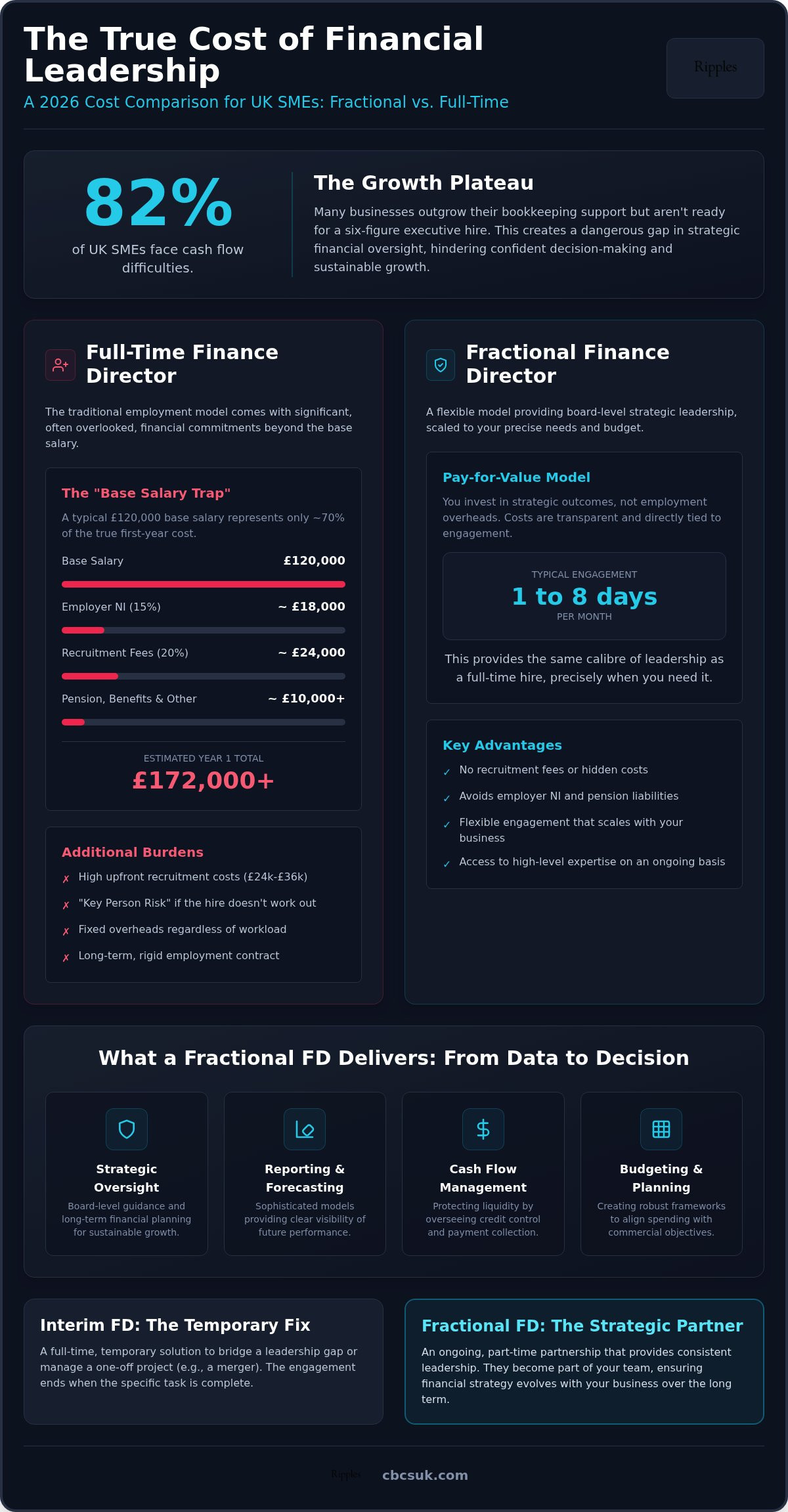
Strategic Oversight: Providing board-level guidance and long-term financial planning to support sustainable growth.
Financial Reporting and Forecasting: Implementing sophisticated models to ensure you always have visibility over your future performance.
Cash Flow Management: Overseeing credit control and payment collection processes to protect your liquidity and bottom line.
Budgeting and Planning: Creating robust frameworks that align your spending with your commercial objectives.
By focusing on these fundamentals, they help you move from reactive decision-making to a position of intentional action.
Fractional vs Interim: Choosing the Right Path
It's easy to confuse fractional support with interim cover, but the two serve very different purposes. An interim FD is typically a temporary, full-time solution brought in to bridge a gap or manage a specific project, such as a merger or a sudden departure. Once the task is complete, they leave.
In contrast, a fractional FD builds an ongoing partnership with your business. They become part of your leadership fabric, providing continuity and stability as you scale. This model is often more effective for SMEs because it allows for a lower fractional finance director cost whilst maintaining a consistent strategic presence. You get the benefit of senior experience that grows alongside your company, ensuring your financial strategy remains aligned with your operational reality over the long term.
Fractional FD vs Full-Time Hire: A Side-by-Side Cost Comparison
Hiring a permanent executive is a significant milestone for any growing company. However, many SMEs fall into what we call the "Base Salary Trap." They focus solely on the gross salary and assume it represents the total investment. In reality, the base salary usually accounts for only about 70% of the true financial commitment. When you evaluate the fractional finance director cost, you're looking at a transparent fee that eliminates the complex, and often rising, layers of UK employment overheads.
The Financial Burden of a Full-Time Senior Hire
A full-time FD currently commands a base salary between £95,000 and £150,000 across the UK market. From April 2026, the employer National Insurance rate stands at 15%. When you add mandatory pension contributions, private healthcare, and professional development, the numbers climb quickly. Hidden costs like high-spec equipment, dedicated office space, and ongoing training also eat into your margins.
Recruitment fees add a substantial upfront burden. Agencies typically charge 20% to 30% of the first-year salary to find high-level talent. For a £120,000 hire, this means an immediate £24,000 to £36,000 cash outflow before the individual has even sat at their desk. There's also the "Key Person Risk." If a full-time hire doesn't work out, you face the same expensive recruitment cycle and lost time all over again. Total year-one costs for a permanent FD often range between £120,000 and £200,000.
The Fractional Retainer Model: Transparency and Control
The fractional model replaces these unpredictable variables with a fixed monthly retainer. You aren't paying for National Insurance, holiday pay, or sick leave. Instead, you pay exclusively for senior-level expertise and strategic oversight. A typical retainer for a growing SME might range from £3,500 to £6,000 per month, which is significantly lower than a full-time equivalent cost that can easily exceed £12,000 per month.
Research suggests that a fractional FD provides leadership at roughly 40% to 55% of the cost of a permanent hire. This structure gives you direct control over your overheads whilst providing the financial clarity you've been missing. If you're currently feeling that your financial data lacks the precision needed for board decisions, exploring fractional finance director support can provide the senior leadership you need without the full-time burden. You gain the ability to scale the support up as your business evolves, or scale back if you need to consolidate, all without the legal complexities of redundancy.
Key Variables That Influence Fractional Finance Director Rates
The fractional finance director cost is not a static figure. It is a tailored investment that reflects the specific needs and risks of your organisation. Whilst day rates provide a baseline, the total commitment is shaped by the seniority of the professional and the depth of involvement required. A director with over 25 years of experience brings a level of intuition and precision that can't be replicated by someone earlier in their career. This seniority allows them to act as a "safe pair of hands" from day one, identifying structural weaknesses that might otherwise go unnoticed.
Frequency of engagement is the most direct multiplier of cost. Some businesses require a light-touch approach of one day per month to maintain board-level oversight. Others, particularly those in high-growth phases or navigating complex supply chains, may need two days per week to manage operational details. Sector complexity also plays a significant role. If your business operates across international borders or involves intricate franchise audits, the level of technical expertise required will naturally influence the rate.
Turnover vs Complexity: What Really Drives the Workload?
It's a common misconception that a higher turnover always equates to a higher workload. In reality, complexity is the primary driver of time. A £2m e-commerce business with high transaction volumes and "messy" historical data often requires more intensive support than a stable £10m consultancy. Cleaning up historical accounts and implementing robust reporting frameworks requires an initial investment of time and focus. Additionally, project-based requirements such as fundraising rounds, statutory audits, or preparing for a business sale will temporarily increase the scope of work beyond the standard monthly retainer.
The Finance Function Hierarchy
A fractional FD doesn't replace your existing team; they empower them. They sit at the top of a structured hierarchy, working alongside your bookkeeper or finance manager to ensure the entire function is moving in the right direction. This model allows you to optimise the fractional finance director cost by delegating lower-level tasks, such as data entry or basic reconciliation, to your existing staff whilst retaining senior oversight for strategic decisions.
This is where Chris Burton’s hands-on philosophy provides distinct value. By getting involved in the operational details of credit control and cash flow management, a fractional FD can streamline your processes and improve efficiency across the board. This collaborative approach ensures that your internal team grows in competence whilst you benefit from the clarity and control that only a seasoned leader can provide.
The ROI of Financial Clarity: Evaluating the True Value
Focusing solely on the fractional finance director cost often misses the broader picture of value creation. When financial leadership is viewed as a strategic investment rather than a line-item expense, the returns become evident in your bank balance and operational stability. Professional cash flow management, for example, frequently reduces the need for expensive short-term debt. By identifying surplus liquidity or refining supplier payment terms, a fractional FD can eliminate the interest costs associated with overdrafts or high-interest bridging loans.
Credit control efficiency provides another immediate impact on the bottom line. Reducing your average debtor days by even a small margin releases significant working capital back into the business. This isn't just about sending automated reminders; it's about implementing robust processes that ensure your cash isn't sitting in your customers' bank accounts. Furthermore, when you prepare for fundraising or a valuation, having a seasoned professional present your numbers ensures you are investor-ready. This often leads to better terms and higher confidence from lenders or private equity partners.
The Cost of Inaction: What Are You Losing?
Many business owners pay a "stress tax" every month, which is the mental burden caused by a lack of visibility over their true financial position. Poor reporting doesn't just cause anxiety; it leads to tangible losses through tax penalties, missed early-payment discounts, or the inability to act on a sudden market opportunity. Financial friction is the hidden cost of reactive management. Without a safe pair of hands to spot these leaks, you aren't just saving on a director's fee; you are losing money through systemic inefficiency.
Case Study Perspective: Moving from Instinct to Informed Action
The transition from surviving to scaling happens when you stop relying on instinct and start using data-driven management accounts. Growing SMEs often reach a plateau where the founder's intuition is no longer enough to manage the complexity of a £5m or £10m operation. Professional budgeting and forecasting provide the roadmap needed to navigate this stage without overextending your resources.
Having a seasoned expert at the board table provides a level of reassurance that allows you to focus on your core strengths. You can pursue expansion or capital investment with the confidence that the numbers have been stress-tested and the risks mitigated. If you want to move beyond reactive survival, you can book a consultation for fractional finance director support to begin your transition toward financial clarity. This shift ensures that every pound spent on the fractional finance director cost is returned through improved liquidity and more precise decision-making.
Partnering with CBCS: Bespoke Financial Leadership for UK SMEs
CBCS, led by Chris Burton, provides a level of senior finance leadership that is often missing in the SME sector. With over 25 years of experience, Chris acts as a "safe pair of hands" for businesses that have outgrown their current accounting support. Our philosophy is centred on delivering clarity, control, and confidence. We believe that a fractional finance director cost should be viewed as a catalyst for stability rather than just another overhead. Unlike large recruitment agencies that act as middle-men, we offer a personal, consultancy-led approach that focuses on your specific operational reality.
We provide a blend of high-level strategic board insight and practical, hands-on operational management. This means we don't just suggest improvements; we help implement them. Whether you are dealing with complex supply chains or need a robust framework for budgeting and planning, we tailor our retainer structures to fit your unique needs. This flexibility ensures you get the exact level of support required to move from reactive survival to intentional growth.
Our Approach to Fractional FD Support
Integration is the cornerstone of our service. We don't operate in a vacuum. Instead, we become a trusted strategic partner who understands your commercial objectives. Our primary focus is often on protecting your bottom line through cash flow management and credit control. We work to maintain liquidity and optimised customer payment terms, ensuring that your working capital is working as hard as possible for you.
Every partnership begins with a detailed financial health check. This initial phase is crucial for identifying immediate risks, such as "messy" data or inefficient collection processes. By addressing these early, we create a solid foundation for more sophisticated financial reporting and forecasting. This methodical approach ensures that the "why" is always understood before we move to the "how," providing a roadmap from complexity toward simplicity.
Taking the Next Step Towards Financial Stability
Assessing your readiness for professional support often involves looking at your current internal friction. If you feel that your bookkeeper has reached their limit, or if board meetings are frequently stalled by a lack of reliable data, the time for a fractional FD has arrived. Our onboarding process is designed to be smooth and reassuring, taking you from a state of financial uncertainty to one of structured, professional reporting.
We help you move away from instinctual decision-making toward a future built on fundamentals and proven experience. If you are looking for a partner who values long-term stability over quick fixes, we are ready to help. Contact us to discuss a tailored fractional FD retainer for your business.
Securing Your Financial Future with Strategic Leadership
Transitioning from reactive cash flow management to intentional growth requires more than just better bookkeeping. It requires a strategic partner who understands the nuances of SME operations. By evaluating the fractional finance director cost against the hidden burdens of full-time employment, you can unlock senior expertise without compromising your company's agility. You've seen how this model releases working capital and provides the board-level visibility needed to scale with confidence.
At CBCS, we bring over 25 years of senior financial leadership experience to help UK founders navigate these complexities. Our hands-on approach specialises in SME cash flow and credit control, ensuring your business remains on a stable footing. We have a proven track record of helping entrepreneurs move away from uncertainty and toward a future of precision and control. Book a discovery call with CBCS to find the right financial leadership for your business.
You don't have to manage these burdens alone. With the right "safe pair of hands" supporting your board, you can focus on what you do best whilst we ensure your financial foundations remain rock solid. Your path to clarity and stability starts with a single conversation.
Frequently Asked Questions
How much does a fractional finance director cost per month in the UK?
Monthly retainers typically range from £2,000 to over £10,000, depending on the required level of involvement and business complexity. For a growing SME, a common range is between £3,500 and £6,000 per month. This fee covers senior strategic leadership without the overheads of a full-time executive. The total fractional finance director cost is significantly lower than a permanent hire when you factor in National Insurance, pensions, and recruitment fees.
Is a fractional FD the same as an outsourced accountant?
No, the roles are distinct in scope and focus. An outsourced accountant typically focuses on year-end compliance, statutory accounts, and tax filings. A fractional FD acts as an internal strategic partner, providing board-level insight, cash flow forecasting, and operational oversight of the finance function. They focus on the future trajectory of your business, whilst a traditional accountant often looks backward at historical data to ensure regulatory compliance.
What is the typical day rate for a fractional FD for an SME?
Day rates for fractional FDs in the UK generally range from £600 to £1,500. Specialist roles or those focused on high-growth fundraising can command rates between £800 and £2,000 per day. Most experienced directors for SMEs sit around the £700 to £900 mark. These rates reflect the level of seniority and the immediate value a "safe pair of hands" with 25+ years of experience brings to your leadership team.
Can a fractional FD help my business secure funding or investment?
Yes, providing strategic financial documentation is a core part of the role. A fractional FD ensures your business is investor-ready by creating robust financial models, sophisticated forecasts, and clear management accounts. They often lead the financial due diligence process and manage relationships with potential lenders or private equity partners. This professional oversight increases investor confidence and helps you secure better terms during funding rounds or bank facility applications.
How many days a week does a fractional finance director usually work?
Engagement levels are flexible and tailored to your specific needs. Most SMEs find that one to four days per month is sufficient for strategic oversight and board reporting. High-growth businesses or those navigating complex projects might require one or two days per week. This scalability is a key advantage of the fractional model, allowing you to adjust the level of support as your business evolves and your requirements change.
Do I need to worry about IR35 when hiring a fractional FD?
IR35 compliance is an important consideration for any off-payroll engagement in the UK. However, fractional FDs typically operate as genuine external consultants with multiple clients, their own equipment, and a clear statement of work. This portfolio structure usually places them outside the scope of IR35. You should always ensure that the contract reflects a business-to-business relationship rather than a disguised employment arrangement to maintain compliance with HMRC regulations.
What happens if my business grows and I need more support?
The fractional model is designed for scalability. If your business expands or faces a complex project like a merger, you can simply increase the number of days your director provides. This flexibility allows you to manage the fractional finance director cost precisely. If you eventually reach a scale where a permanent, full-time hire is necessary, your fractional FD can help manage the recruitment and onboarding process to ensure a smooth transition.
Will a fractional FD manage my existing bookkeeping team?
Yes, providing operational oversight of the finance function is a fundamental responsibility. A fractional FD sits at the top of the finance hierarchy, working alongside your bookkeeper or finance manager to ensure accuracy and efficiency. They mentor existing staff, streamline processes like credit control, and ensure that daily transactions align with broader strategic goals. This leadership ensures that the entire team operates with clarity and professional discipline, moving from reactive tasks to intentional action.



Comments