
Fractional FD vs Full-Time: Which is Right for Your SME in 2026?
Is the most expensive hire you make this year the one with the highest salary, or the one whose full-time capacity you simply cannot use yet? For many UK business owners, the debate of a fractional fd vs full time leadership often surfaces just as growth starts to feel unmanageable. You might feel overwhelmed by complex forecasting or anxious about making strategic decisions without senior validation. It's a common pressure point where the need for a safe pair of hands meets the reality of a tight SME budget.
We understand that you want to regain control of your numbers without the £150,000 burden of a permanent executive. This article explores the strategic and financial differences between these two models to help you choose the right path for your growth in 2026. We'll examine how to secure senior-level insight, manage financial risks whilst scaling, and determine which leadership style provides the visibility your business requires to thrive in a changing regulatory environment.
Table of Contents
The Financial Leadership Gap: Why Growth Often Outpaces Control
Success often creates a paradox for UK business owners. As your turnover increases, your visibility into what is actually driving profit frequently decreases. You might have started your business relying on intuition, a method that works well in the early stages. However, every growing SME eventually hits the "Founder's Ceiling". This is the point where instinct-based financial decisions fail to account for the complexities of a larger operation, leaving you feeling like you're flying blind.
There is a significant difference between keeping the books and driving a strategy. Whilst a bookkeeper or a year-end accountant ensures you remain compliant, they rarely provide the commercial insight required to scale. You might recognise the signs that your current structure is straining: your board meetings lack data-driven confidence, or you find yourself profitable on paper but perpetually short on cash. The psychological cost of this uncertainty is high, often manifesting as persistent executive anxiety and a fear of making the next big investment.
From Reactive to Intentional Financial Management
The transition from survival mode to strategic scaling requires a shift in how you view your numbers. Financial clarity is the foundation of confident leadership, providing the precise visibility required to move from reactive survival to intentional scaling. By adopting a fractional executive model, you can bridge this gap without the immediate need for a six-figure salary. When evaluating a fractional fd vs full time commitment, the decision usually rests on whether you need a permanent presence or a targeted strategic intervention to regain control.
The Burden of the "Part-Time Accountant" Trap
Many SMEs fall into the trap of relying solely on a compliance-focused accountant for strategic advice. Statutory reporting is essential for HMRC, but it doesn't help you identify cash flow bottlenecks or optimise your margins. This lack of senior oversight often leads to missed opportunities and reactive firefighting. The debate of fractional fd vs full time leadership often surfaces when you realise that a general practice accountant cannot provide the day-to-day commercial depth your business needs. A "safe pair of hands" provides the strategic oversight that ensures your financial foundation is as robust as your growth ambitions.
Defining the Models: Fractional vs Full-Time Finance Directors
Choosing between a fractional fd vs full time leadership isn't merely a budgetary decision. It's a choice about the rhythm and requirements of your business. In 2026, the fractional model has transitioned from a niche service to a mainstream strategic choice for UK SMEs, particularly those with a turnover between £2 million and £15 million. This "Expert on Tap" approach allows you to access the same senior-level expertise as a multinational corporation, but only for the specific days or hours your business actually requires.
The core difference lies in the scope of engagement. A full-time director is a permanent fixture in the organisational structure, often deeply involved in both the broad strategy and the daily operational management. In contrast, a fractional FD focuses almost exclusively on high-impact strategic outcomes. They provide the "safe pair of hands" needed to navigate complex financial landscapes without the inertia that can sometimes come with a permanent executive headcount.
The Fractional FD: Strategic Insight on a Retainer
A fractional Finance Director functions as a dedicated partner who integrates with your existing team. They don't replace your bookkeeper or controller; they elevate them. By providing high-level financial reporting and forecasting, they ensure your daily operations align with your long-term growth objectives. This model is a favourite amongst ambitious UK entrepreneurs because it offers professional seniority without the long-term commitment. You gain the visibility to manage cash flow and prepare for upcoming regulatory changes whilst keeping your overheads lean and agile.
The Full-Time Hire: When 40 Hours are Essential
There is a threshold where a business's complexity demands a permanent presence. This typically happens when turnover exceeds £15 million or when the volume of daily strategic decisions requires an executive on-site every day. However, the financial commitment is substantial. By early 2026, the average salary for a Finance Director in the UK reached approximately £121,145. When you account for National Insurance, pension contributions, and bonuses, the total employer cost often climbs to between £110,000 and £180,000 annually.
When evaluating a fractional fd vs full time director, you must assess if you have 40 hours of truly strategic work available each week. If a high-salaried director spends half their time on transactional tasks, the return on investment diminishes. The fractional model avoids this "talent wastage" by focusing strictly on the senior-level pillars of budgeting, planning, and risk management that drive real value.
The Economics of Expertise: Comparing Costs and ROI
The decision between a fractional fd vs full time director often boils down to a simple question of resource allocation. In 2026, the total annual employer cost for a permanent Finance Director, including National Insurance, pension contributions, and benefits, typically sits between £110,000 and £180,000. For an SME, this represents a significant portion of the payroll. If that individual spends their time on daily transactional management, you are essentially paying an executive premium for mid-level administrative output.
Fractional FD rates focus on outcomes rather than attendance. Typical engagements of one to two days per week cost between £30,000 and £70,000 annually. This modular approach allows you to secure senior-level insight without the full-time salary burden. The risk of making a wrong full-time hire is also mitigated; recruiting the wrong permanent executive can cost a business upwards of six months' salary in lost time, cultural disruption, and recruitment fees.
Breaking Down the Fractional Retainer Model
Fractional fees align directly with business value and specific deliverables. You aren't paying for a desk to be occupied; you're paying for a seasoned expert to solve specific problems. By focusing solely on senior-level tasks like strategic budgeting and planning, the fractional model ensures every pound spent contributes to the bottom line. Fractional support protects working capital by providing the high-level expertise needed to optimise cash cycles without committing the business to a rigid, high-cost permanent overhead.
The Long-Term Value of Strategic Financial Planning
Senior financial leadership pays for itself through improved cash flow management and robust credit control. A "safe pair of hands" identifies where money is trapped in the business and implements systems to release it. This strategic oversight is particularly vital when navigating the 2026 regulatory landscape, such as the dividend tax rate increase or the National Living Wage rise to £12.71 per hour. These changes require intentional planning rather than reactive adjustments.
Strategic forecasting prevents costly missteps during expansion. When you are "investor-ready" at all times, you can seize opportunities that less prepared competitors might miss. The debate over fractional fd vs full time leadership is ultimately about which model provides the highest return on your most precious resource: your capital. By choosing a model that scales with you, you ensure that senior expertise remains an asset rather than a financial burden.
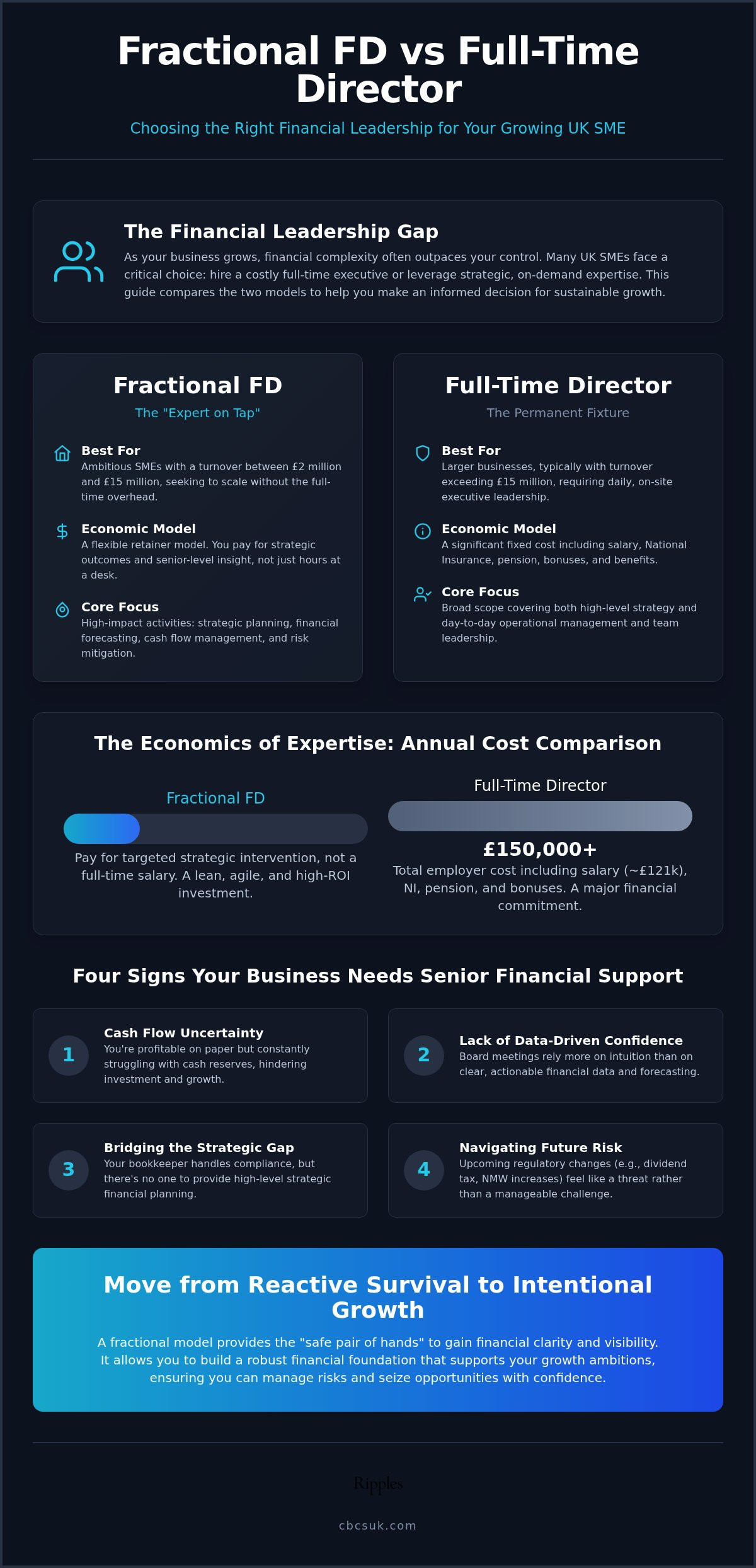
Evaluation Framework: Four Signs Your Business Needs Fractional Support
Deciding between a fractional fd vs full time hire often comes down to identifying specific operational bottlenecks that instinct alone cannot solve. If your business is growing but your sense of control is diminishing, you've likely reached a common transition point. We've identified four critical signs that suggest your SME requires the steadying influence of a senior finance professional.
Sign 1: Profitable but perpetually short on cash. If your profit and loss statement looks healthy whilst your bank balance remains strained, your cash cycle is inefficient. You need more than basic bookkeeping; you need a "safe pair of hands" to implement robust credit control and cash flow management.
Sign 2: Board meetings lack data-driven confidence. When leadership discussions revolve around debating the accuracy of spreadsheets rather than strategic growth, visibility is lost. Senior financial leadership provides the clarity required to make big decisions with certainty.
Sign 3: Impending "Strategic Projects". Preparing for a sale, securing funding, or managing an acquisition requires specialist expertise. These aren't daily tasks, but they require a level of precision that an internal team often cannot provide.
Sign 4: The founder is still the primary "Finance Manager". If you are still personally approving every invoice or managing the payroll, you're trapped in reactive behaviour. You've outgrown your current structure when your time is better spent on leadership than on transactional details.
Assessing Your Current Finance Function
It's vital to distinguish between a finance function that records history and one that provides visibility. Bookkeeping tells you what happened last month; strategic forecasting tells you what will happen in the next six. To apply the "Board-Level Test", ask yourself if you could present a three-year financial roadmap to a potential investor today. If the answer is no, there's a gap in your budgeting and long-term planning that a fractional partner can bridge.
Choosing Between Fractional and Interim Support
Whilst they sound similar, fractional and interim roles serve different purposes. Interim support is typically a short-term solution for crisis management or covering a gap between permanent hires. In contrast, the fractional model is built for long-term stability and ongoing strategic health. At CBCS, we provide a steady, consistent presence that scales with your business rhythm. This ensures your financial risks are managed by someone who understands your sector's specific challenges whilst remaining a flexible resource. To regain control of your business numbers, explore our Fractional Finance Director Support to see how we can provide the strategic clarity you need.
Beyond the Retainer: How CBCS Delivers Strategic Clarity
The CBCS philosophy is built on the belief that senior financial leadership should be accessible, practical, and deeply integrated into your business operations. Led by Chris Burton, who brings over 25 years of senior finance leadership experience, our approach is designed to provide the "safe pair of hands" that many UK SMEs currently lack. We understand that the choice between a fractional fd vs full time director isn't just about the numbers on a spreadsheet; it's about the peace of mind that comes from knowing your financial risks are professionally managed.
Our transition process is methodical and thorough. We move your business from a state of reactive confusion towards a destination of strategic simplicity. This isn't a superficial fix; it's a long-term investment in stability that ensures your growth is supported by robust fundamentals rather than instinct alone. By choosing a fractional partner, you secure the high-level expertise needed to navigate the economic shifts of 2026 whilst maintaining the flexibility your SME requires.
A Partner, Not Just a Consultant
Chris Burton integrates directly with SME leadership teams to foster precision, visibility, and empowerment. He doesn't operate as a distant advisor but as a hands-on partner who is willing to get involved in the day-to-day operational details. This ensures that your financial reporting and forecasting are not just compliant, but commercially useful. By moving from instinctual behaviour to informed, intentional action, you can lead your organisation with a renewed sense of confidence and authority.
When weighing a fractional fd vs full time hire, the most immediate benefit of the CBCS approach is the removal of executive anxiety. You gain a seasoned mentor who understands the human element of leadership and decision-making. This relationship is built on trust and a commitment to long-term stability, ensuring you have the financial voice you need at the board table without the burden of a six-figure executive headcount.
Your Next Steps Towards Financial Control
Regaining control of your business starts with a simple conversation. Preparing for your first discovery call involves identifying your primary financial pain points, whether that's cash flow uncertainty or a lack of clarity in your board reports. Within the first 90 days of fractional support, we aim to stabilise your reporting structures and establish a clear roadmap for your financial future. This pace is deliberate, giving you time to absorb the importance of each professional pillar before moving to the next.
This partnership is designed to reduce the burden on founders, allowing you to focus on your core strengths whilst we manage the complexities of budgeting and planning. If you're ready to transition from uncertainty to stability, now is the time to act. Book a discovery call with CBCS to regain control of your numbers and discover how senior financial leadership can transform your business growth.
Securing Your Financial Future in 2026
The choice of a fractional fd vs full time director defines how your business navigates the complexities of growth. You don't need a six-figure permanent executive to achieve professional precision; you need a strategic partner who delivers senior-level outcomes whilst protecting your working capital. By addressing the financial leadership gap now, you move from reactive survival to intentional scaling. This transition provides the visibility required to manage cash flow and regulatory shifts with absolute confidence.
Chris Burton brings over 25 years of financial leadership experience to this hands-on, strategic partnership model. His expertise in SME cash flow and forecasting ensures your business remains in a safe pair of hands throughout its expansion. If you're ready to remove the confusion and regain control of your numbers, book a discovery call with Chris Burton at CBCS today. Taking this step ensures your financial foundation is as robust as your ambitions for the future.
Frequently Asked Questions
What exactly is a fractional finance director?
A fractional Finance Director is a senior executive who provides board-level financial leadership on a part-time or flexible basis. They don't just offer advice; they act as a member of your leadership team. They take ownership of high-level strategy, financial reporting, and forecasting. This model allows SMEs to access 25 years of senior experience without the overhead of a permanent six-figure salary.
How many days a month does a fractional FD typically work?
The engagement length depends entirely on your business's complexity and specific needs. Typically, a fractional FD works between one and four days per month for most SMEs. Some businesses require a more intensive presence during periods of rapid growth or strategic change, whilst others maintain a steady one-day-a-week rhythm. This flexibility is a key advantage when comparing a fractional fd vs full time commitment.
Is a fractional FD the same as an outsourced accountant?
No, the roles are distinct and serve different purposes. An outsourced accountant usually focuses on compliance, tax returns, and year-end filings. A fractional FD provides commercial insight and strategic direction. They look forward through budgeting and planning, rather than just recording historical data. While your accountant ensures you meet statutory requirements, your FD ensures your financial strategy supports your long-term growth ambitions.
Will a fractional FD help with my business funding application?
Yes, providing senior-level documentation for funding is a core part of our advisory services. We help you prepare robust financial forecasts, detailed budgets, and the strategic narratives that investors or lenders require. Having a "safe pair of hands" with over 25 years of experience to validate your numbers significantly increases your credibility during the application process. We ensure your business is "investor-ready" at all times.
Can a fractional FD manage my existing finance team?
Yes, a fractional FD often acts as a mentor and manager for your internal finance staff. They provide the senior oversight that bookkeepers or junior controllers need to excel in their roles. By implementing better systems for cash flow management and credit control, the FD empowers your existing team to work more effectively. This leadership ensures that the entire finance function operates with precision and intentional action.
What happens if my business grows and I eventually need a full-time FD?
We view our role as a bridge to your business's next stage of maturity. If your growth reaches a point where a 40-hour weekly commitment is essential, we can help you manage that transition. This includes defining the new role, assisting with the recruitment process, and ensuring a smooth handover. The goal is long-term stability, whether that involves a fractional fd vs full time hire in the future.
How does the cost of a fractional FD compare to a recruitment fee for a full-time hire?
The initial recruitment fee for a permanent Finance Director in the UK often exceeds £20,000 to £30,000 alone. In contrast, a fractional FD requires no such upfront cost and operates on a flexible retainer. When you consider the total employer costs of a full-time hire, including National Insurance and pensions, the fractional model often provides the same strategic value at approximately 35% to 40% of the annual expense.
What specific sectors does CBCS specialise in for fractional support?
CBCS works with UK SMEs across a wide variety of sectors. Our experience is rooted in the fundamental pillars of financial health: clarity, control, and confidence. Whether you operate in manufacturing, professional services, or retail, the principles of robust cash flow management and strategic budgeting remain the same. It's a focus on delivering practical, hands-on leadership to any business owner who feels overwhelmed by their financial reporting.



Comments